I woke before sunrise, the November air in Phoenix carrying that cool, rare softness that only lasts until mid-morning. Veteran’s Day always sneaks up on me—not because I forget, but because of how it makes the city feel. Flags appear on porches, the streets go a little quieter, and for a few hours the desert seems to hold its breath. I strapped my bike onto the rack, tossed a helmet, gloves, and a half-smashed protein bar into my pack, and headed for South Mountain.
The trailhead parking lot was already stirring. I spotted a guy in a faded camo jersey, stretching next to a dusty Tacoma. He looked mid-40s, the posture of someone who carried a pack for too many years and learned to keep scanning the horizon even when he didn’t mean to. We nodded that desert nod you give to strangers on the same mission.
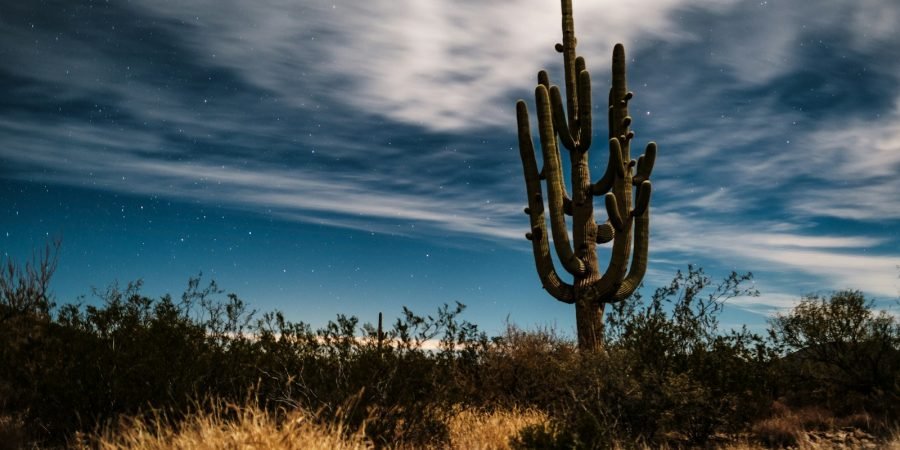
I started up Desert Classic—gradual, rolling, a good warm-up for lungs that forget how to work once the heat comes back. The creosote smelled like rain that never fully arrived. The earth was stippled with cholla, and the sky over Ahwatukee began to glow. I could feel my heart doing its early ride stutter, panic nibbling at the edges. It’s always worse at the beginning: the voice that says, turn around, this is dumb, you’re not strong enough for today.
I breathe in for four, out for six. Count the pedal strokes. Notice the crunch under my tires, the way the trail threads between rocks, the distant buzz of traffic that softens into wind. My therapist calls it anchoring. On the bike, it’s survival.
At the first overlook I stopped, took off my helmet, and let sweat evaporate into the cold air. Below, Phoenix sprawled in a patchwork of cul-de-sacs and palms, the downtown skyline like a child’s block set to the far north. Somewhere out there, people were lining up for free pancakes at diners, flags clipped to their antennas, one hand over the heart. Behind me, tires rolled up and the guy in the camo jersey pulled alongside. We traded small talk—the usual ride banter about lines and tires and whether the rock garden on National would feel polished or grippy today.
“You riding alone?” he asked.
“Usually. Easier to manage my head that way,” I said before I could filter it. The desert has a way of making confession seem normal.
He nodded like he understood. “I come out here for the same reason. Some days the only quiet I can find is on the trail.”
We pedaled together for a mile, single file through saguaro silhouettes. He didn’t push the pace, and I didn’t try to prove anything. On a short climb, my legs burned, and I stood to grind it out, breathing loud. At the top, he pulled even again.
“You ever go to the Vet Center in Tempe?” he asked, like he was asking about a local bike shop.
I shook my head. “I’m not a vet.”
“Doesn’t matter. I mean, it does—those services are for us—but the idea is the same. You find your people. For me, it’s them and mornings like this.”
We let that sit. He told me he’d done two deployments and stopped sleeping through the night sometime in 2009. He tried running, tried lifting, tried whiskey. Mountain biking stuck because you can’t think about anything else when the rocks get big. The trail demands your attention in a way anxiety can’t compete with.
When we split at the base of National Trail, he went up—the kind of rider who scans the ridgeline and sees challenge as a gift—and I kept rolling east on Desert Classic. My chest felt lighter than it had all week, like the desert had sunned the mold right out of me.
By mid-morning, the heat started to arrive, that Phoenix switch-flip you never fully prepare for. I turned back toward the lot, cruising past dog walkers and parents pushing jogging strollers in a parade of hydration packs and mesh hats. At the last little dip, a rookie mistake: I looked at the cactus instead of the trail and my front wheel washed out. The crash wasn’t dramatic, just a dusty lay-down. I sat there on my elbow, laughing because it felt great to be mad about something simple. Pain with clean edges.
The Army cap guy rolled up and braked. “You good?”
“Yeah,” I said, checking my knee. “Ego bruise.”
“Best kind.” He offered a hand, pulled me up. “You coming to the Veteran’s Day thing at Steele Indian School Park? They do a nice ceremony.”
I hesitated. Crowds and speeches are not usually my scene. But I pictured the flags, the families under shade tents, the quiet after the anthem. “Maybe,” I said. “I’ll try.”
He grinned. “If you see me, pretend we planned it.”
Back home, I rinsed dust off my arms and watched it spiral down the drain like desert rain. I made coffee and sat on my porch, the saguaro I planted last spring standing awkward and heroic in a terracotta pot. I thought about how the ride reorganized my brain, like the rocks knocked things back into place. I thought about the way Phoenix holds so many stories that don’t brag about themselves: a neighbor leaving a folded lawn chair at a bus stop, a teacher on a Saturday morning hauling boxes into a classroom, a vet who sleeps better after a hard climb.
In the afternoon I drove to the park. The ceremony was exactly what he’d said—simple and kind. A brass band, a color guard, applause that felt more like gratitude than noise. The sun sat high, the grass smelled like warm water, and I kept shaded under a mesquite tree with a paper cup of lemonade. I didn’t see the Army cap in the crowd, but strangely that didn’t matter. Knowing he might be there was enough.
On the drive home, I passed a mural near downtown: a soldier’s silhouette against a desert sunset, wheel marks cutting through the sand like a heartbeat. Someone had painted one word underneath it: Home.
Maybe that’s the work of days like this. Not to cure anything in one shot, not to pretend the mind doesn’t wander to dark places at 2 a.m., but to stitch together small proofs that we belong—to a trail, to a city, to each other. The bike will be ready tomorrow, and the mountain will be there, patient as always. For now, I’ll take the aching calf, the dusty knee, the faint sunburn line where my glove ends. I’ll take the way Phoenix says, in its own dry language, keep going. And I’ll hold a quiet thank-you for the folks who carried weight the rest of us will never fully understand—who find their breath again on the same trails where I find mine.
If you’re reading this and the day feels heavy, try this: step outside. Find a patch of sky. Count your breaths. If you can, ride. If you can’t, walk. If you can’t do either, sit in the sun and let the heat remind you that you’re still here. In this city, on this day, that’s more than enough.